The Case for Creative Destruction in the Pentagon
The private sector has held up its end of the bargain in defense innovation; it's time the Pentagon policymakers uphold theirs


In 1942, economist Joseph Schumpeter coined the term creative destruction to describe the transformative power of entrepreneurs-- how they deliver economic progress in abrupt bursts that destroy the old ways of doing business. The automobile and assembly line destroyed the horse and buggy, smart phones crushed the industry of landline phones; streaming services devastated Blockbuster.
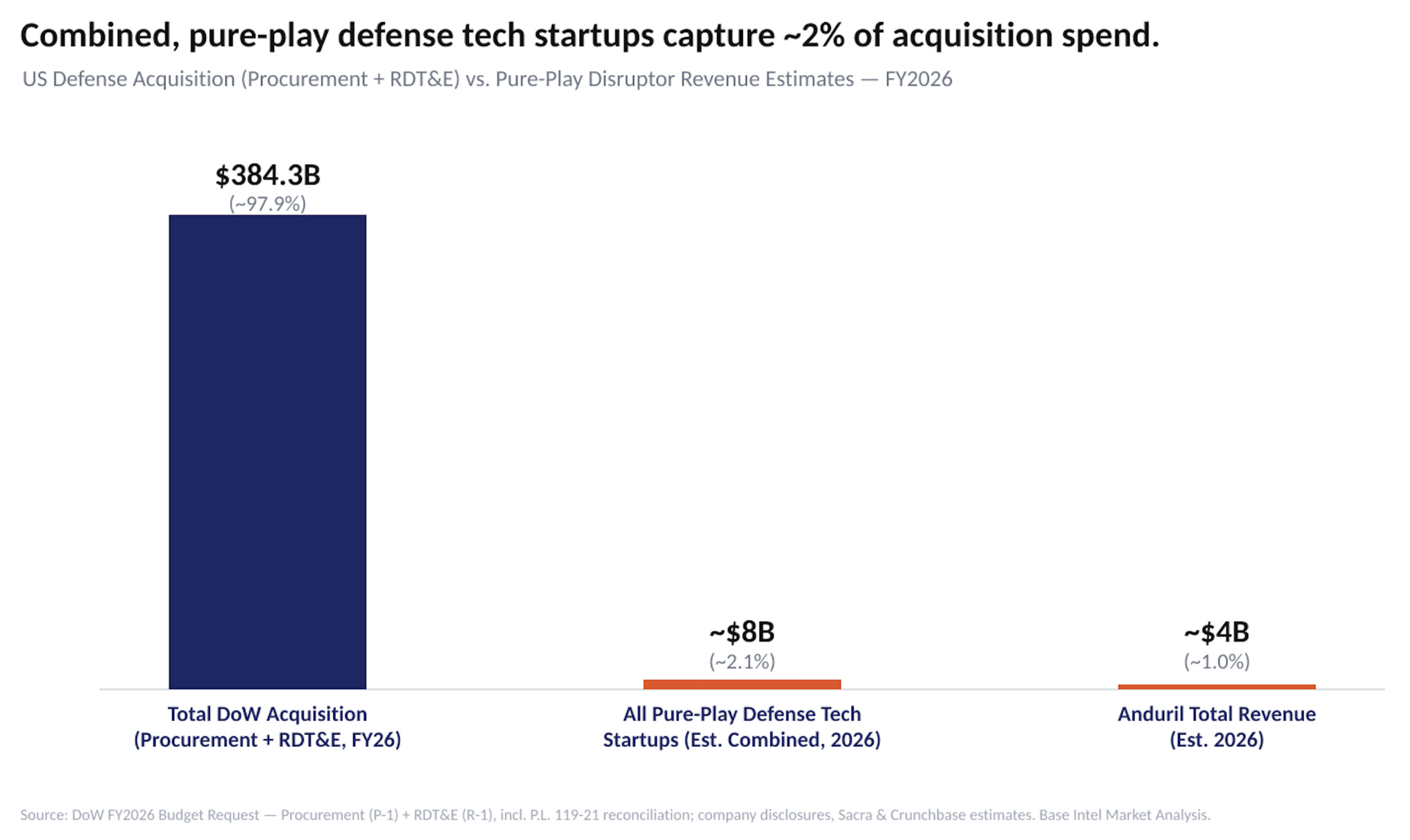
We are undoubtedly in a period of creative destruction in defense technology, yet it feels like we could be doing better. As I write this, defense tech upstarts only occupy ~2% of the DoW’s physical acquisitions spend (Anduril is roughly half of that). Yet, the Federal News Network recently declared “manufacturing is the next bottleneck,” and it’s directionally correct, but this assertion is trying to pull weight it simply cannot pull. We cannot have attritable autonomous systems without the manufacturing capacity to produce them, but it presupposes the policy work from the DoW is done. The red tape’s been cut, and the demand from the defense industry is plentiful and unambiguous, so it’s time to [build, reindustrialize, American flag emoji, etc].
It’s not. Of course, the DoW cannot and should not sacrifice the levels of trust and vetting necessary when making hardware and software for troops. At the same time, acquisitions as they stand are almost biblically slow, and the acquisitions status quo cannot stand as-is (Luke Chen demonstrates how Ukraine makes fast acquisitions work in his piece here). The specific bottleneck within defense manufacturing is regulatory, and DoW policy makers need to hold up their end of the bargain in defense innovation and adopt an ethos of creative destruction in acquisitions policy.
A macro view of manufacturing
Let’s begin with a high-level data point pictured below…
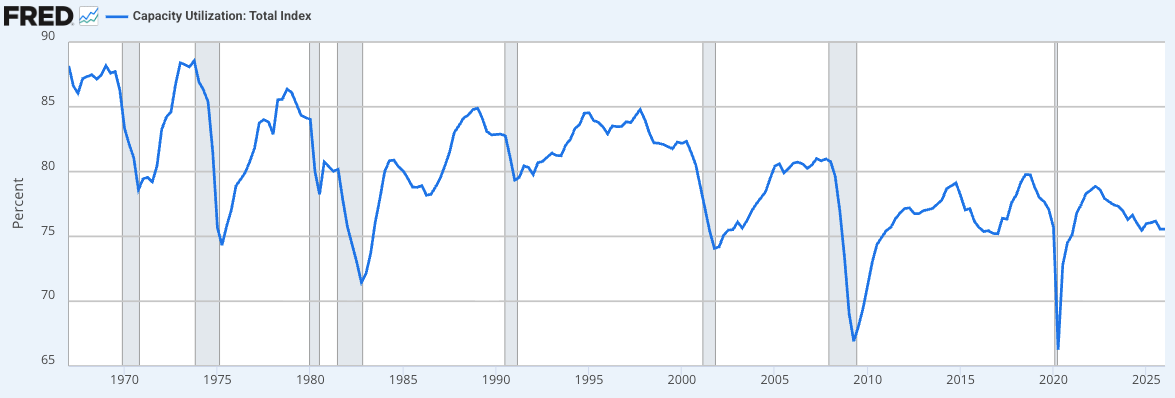
Capacity utilization is effectively-- if a country was a factory-- how much of that factory is turned on and working. US manufacturing stood at a 75.7% capacity utilization in May 2026; this is ~2.5% below its average from 1972 to 2025. So, essentially 25% of aggregate American manufacturing is sitting idle. Doesn’t it, then, follow that capacity utilization would be at or near 100% if manufacturing were the bottleneck in the way many imply it is? At the same time, I don’t want to be misleading: the Fed lacks a granular utilization rate for defense and space production. Floor space is only one variable among countless-- raw materials, transportation, tracking, and compliance are just a handful.
Raw floor space isn’t enough: a defense-specific case study
The Army made a laudable push to revitalize the ammunition industry in 2025 through a clear mandate to build new factories. Mesquite made metal parts, Camden for load-assemble-pack, Parsons, and IMT in Ingersoll. There were nine ribbon cuttings and $5.5 billion of investment toward these efforts in 2025.
The key here is what happened ex-post. The plant in Mesquite produced no conforming 155 rounds as of 2026. The construction is complete, yet output remains at zero. Variables beyond the building and equipment belie failures like this. Here are a few likely culprits:
First article testing-- a quality assurance process by which the government conducts documentation review, physical inspection, and functional testing of a product made for the government-- and can add significant delays to even starting production. First article tests did precisely that for the Mesquite plant.
Long lead times for much of the equipment that makes the things factories make-- such as flow forming machines-- can add months onto the time it takes to get factories online.
The supply chain remains brittle no matter how many software-defined manufacturing facilities we build. As it stands, the only US-based manufacturer of combustible cartridge cases is a single facility at the San Andreas Fault in Coachella Valley.
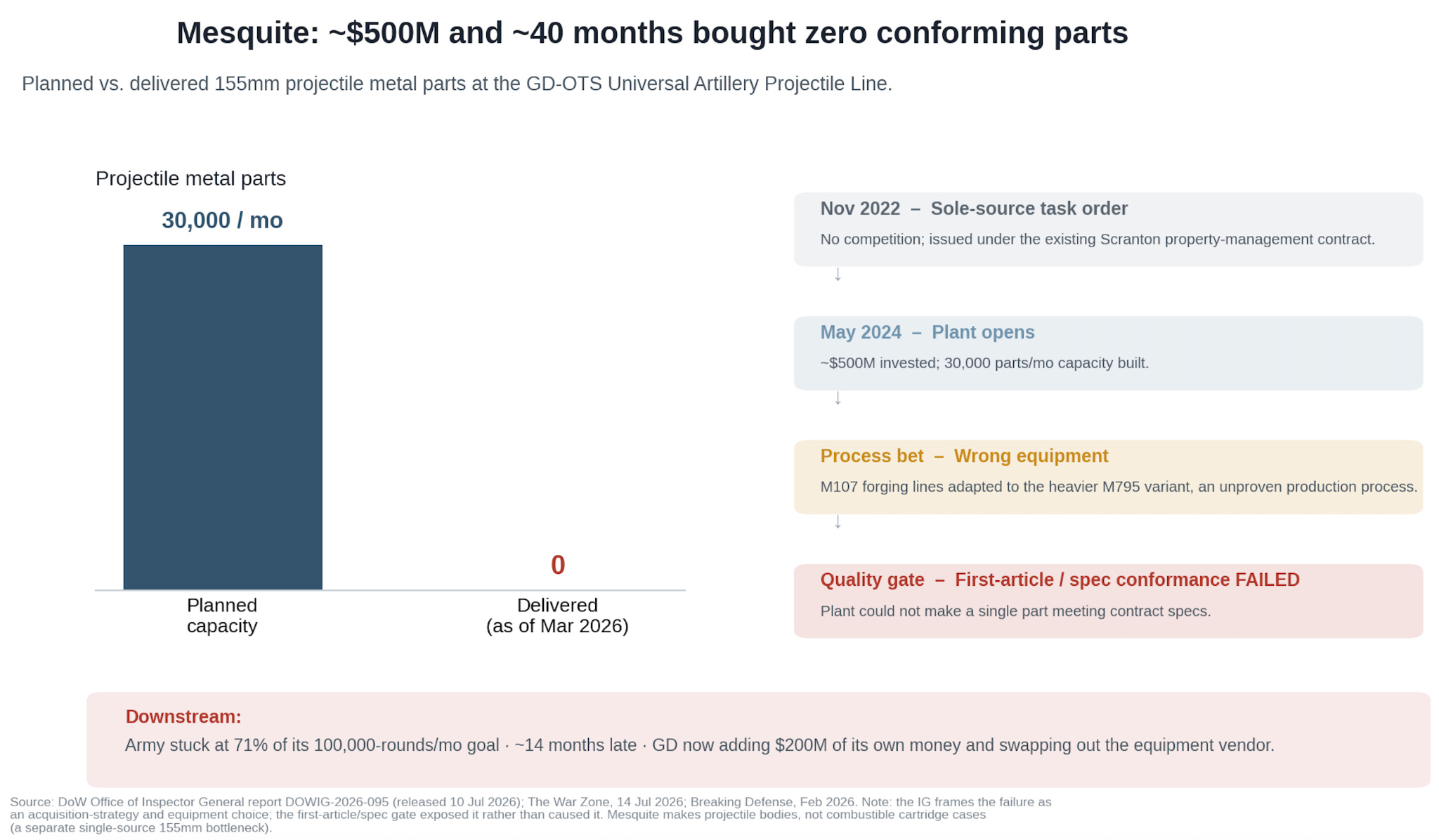
These are only a few constraints that can stop a new factory from producing a single unit; never mind the innumerable obstacles manufacturers face once production does start. Most importantly, floor space will not ameliorate these problems, as supply chain and red tape constraints persist no matter how many factories exist. “Just build factories” discourse underestimates single source fragility and lack of coordination that proved the undoing of the Army’s push to manufacture more 155 shells. Production failures like this are chiefly policy failures.
Neoprimes and red tape
The Army and General Dynamics-- the old establishment-- were behind the Mesquite plant; this invites the question: “is the bottleneck regulatory for defense tech upstarts, too?” It is. Qualification-- the formal verification process to ensure a system’s design and manufacturing process meets various DoW standards-- significantly impacts defense tech startups trying to scale. First article inspection, qualified parts lists, and source approval requests stretch out timelines to deliver capabilities to the DoW far beyond the timelines defense upstarts aim to deliver them.
Ursa Major offers a deeper analysis of how regulations like parts and production qualification create bottlenecks in delivering capabilities-- even for agile upstarts. Let’s put together a broad timeline of Ursa Major’s solid rocket motor (SRM) development timeline to date:
April 2024: Ursa Major signed a contract with the Naval Energetics Systems and Technologies (NEST) to prototype an Mk 104 solid rocket motor for the Navy’s Standard Missile program.
September 2024: the Navy, and Office of Strategic Capital invested $25mm in Ursa Major to produce a highly loaded grain (HLG) SRM. HLG designs pack more propellant into traditional SRMs.
September 2025: Ursa Major broke ground on a 400 acre SRM test and qualification site.
February 2026: the $25mm Navy/OSC pathfinder concludes with a 10-inch HLG prototype meeting performance objectives.
Let’s now be precise about what Ursa Major did and did not render out for the DoW. This timeline rendered a characterized prototype 10-inch HLG after 17 months-- neither production nor qualification. There are no current disclosures for the Mk 104 effort and ostensibly no result.
The story here is only partially there being relatively little to show for roughly two years of effort. Ursa Major’s manufacturing process-- Lynx-- emerges as an interesting tell of the devil being in the details of regulation for defense manufacturing. In this case, the qualification process has created the need for Lynx. Lynx’s competitive claim enables “physics-based process qualification rather than motor-by-motor product qualification.” Consequently, every variant, diameter change, and customer-specific tweak doesn’t require a full independent qualification campaign. Instead, only the process needs re-qualifying when something outside its envelope changes.
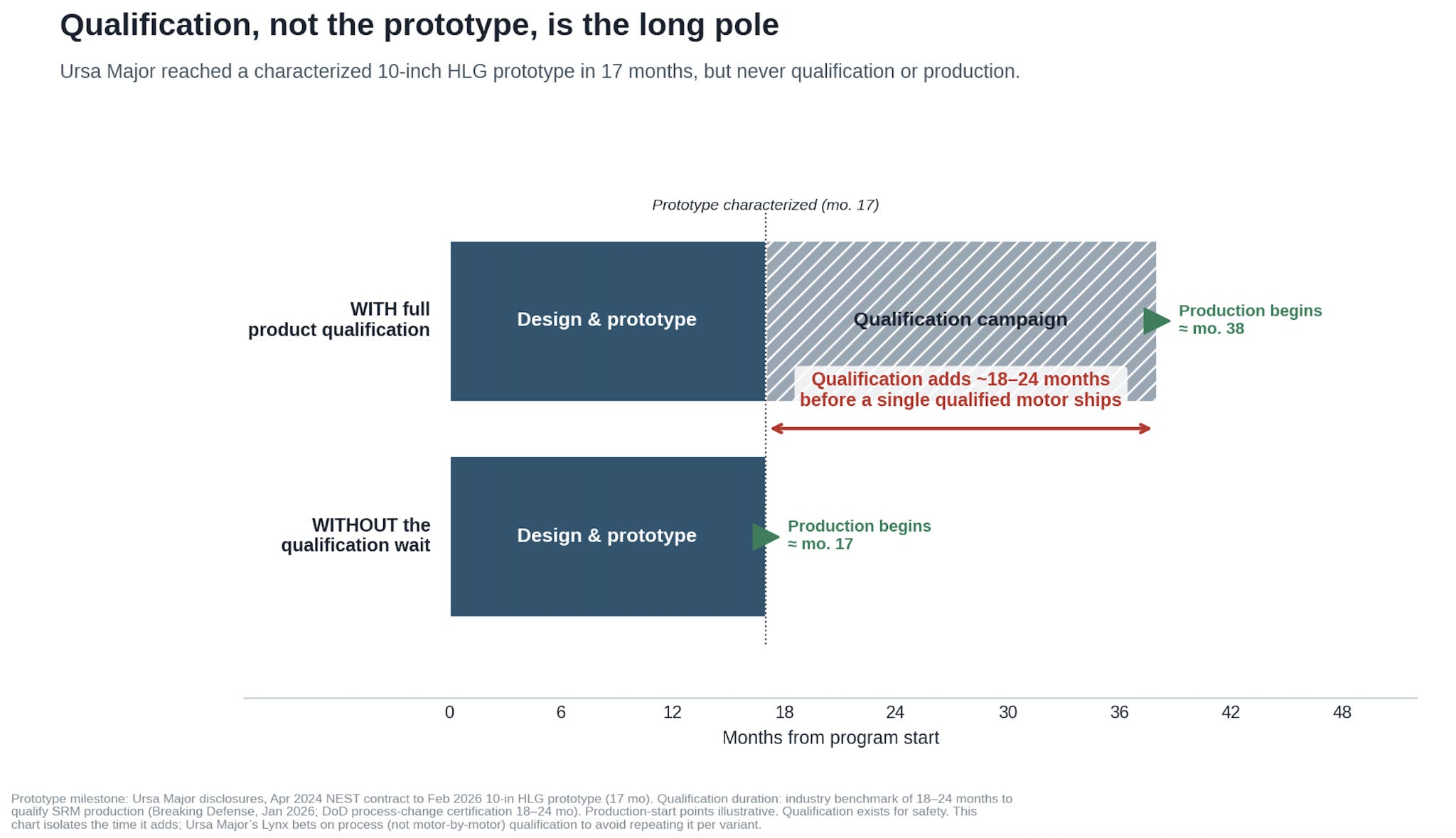
A propulsion company’s central competitive claim is about the qualification method rather than the motor, and this qualification method is narrow, specific, and isn’t necessarily correlated with floor space. Ursa Major understands the bottlenecks they are up against are regulatory; the fact that a way around a massive regulation is a legitimate moat in defense tech signifies that the regulation might be a little excessive, still. Yes, defense tech startups need to hold up their end of the deal-- deliver capabilities that are reliable, intuitive to end users, and can be produced at scale. At the same time, the public sector needs to find a way to catch up with how private capital has flooded into defense tech. Defense tech is undoubtedly frothy, but there is no doubt the white space for disruption in defense is still plentiful, and regulatory burden is the limiting factor for that disruption.
How the private sector is holding up its end of the defense innovation bargain
Arkenstone Defense and Silkline are two defense tech upstarts holding up the private sector’s end of the defense innovation. Their work highlights the need for the public sector to catch up with the private sector in defense tech. Arkenstone Defense recently emerged from stealth and embraces what’s boring in defense tech-- the oft-invisible obstacles that can and do keep phenomenal capabilities from getting to market like export controls, audits, and facility clearances, to name a few. Co-founder Peter Dixon and his team recognize a specific bottleneck (and failure point) within defense tech: the back office that emerges from regulatory requirements. Isaac Chambers and Brent Shulman of Silkline have similarly zeroed in on a specific bottleneck within defense manufacturing since 2023 and serve customers like Castelion and Astranis. Silkline’s software delivers unprecedented visibility for manufacturers within sourcing, tracking, procurement, monitoring, and compliance.
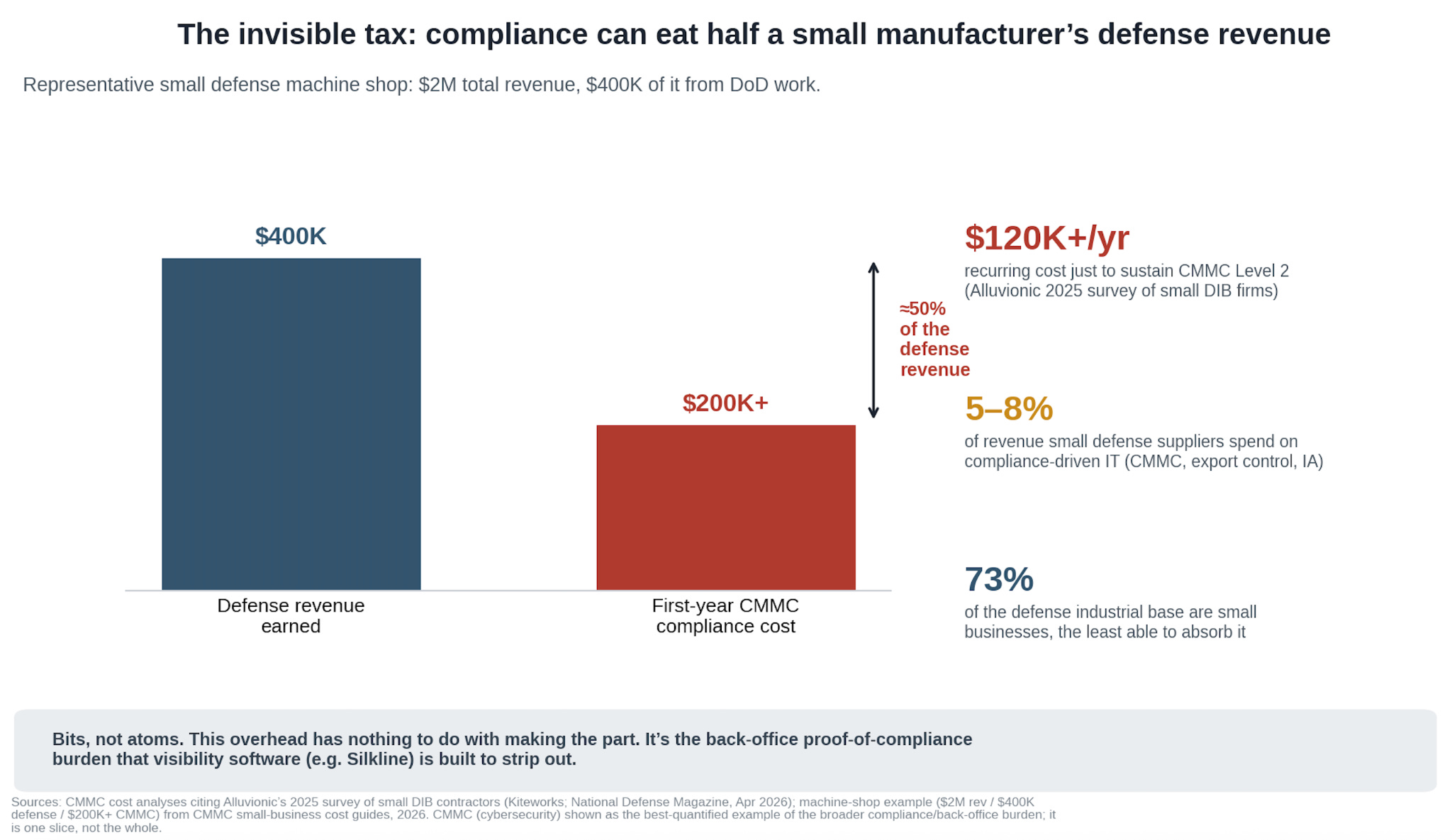
This phenomenon proves no different within defense manufacturing: there are specific bottlenecks, and they often emerge from regulatory requirements that’ve nothing to do with atoms and everything to do with bits. Companies like Arkenstone Defense and Silkline are emblematic of the private sector doing all it can to modernize our military-- despite a vast tapestry of policy that often works against modernization efforts. They are the glue to the creative destruction of defense tech, and it’s time DoW Pentagon try some creative destruction of their own. The Pentagon must completely discard regulatory frameworks that hamper the work of upstarts like Ursa Major and replace them with frameworks aimed to produce everything the Pentagon says it wants out of defense innovation. The proverbial iron is white hot; it’s time for DoW policymakers to strike it.
My thanks go out to Trista Li, Aaron Pickard, and Isaac Chambers for their thoughtful feedback in my composing this. Check out Aaron and Trista’s work, and check out what Isaac and the Silkline team are building.