...so, what does Palantir actually do?
And what it tells us about success in defense innovation

The completely made up tasting notes (“bakers chocolate?” really?) in the red wine you tried one time, the acronym at work you learned early on and still don’t know so you’re just praying no one asks what it stands for, and Palantir-- all things we talk about often but don’t really understand. I asked a dinner table of like-minded friends if they know what Palantir actually does, and I got wide eyes and shaking heads. They asked me if I know myself, to which I said, “I know they help integrate data for the federal government and that’s about it.” It seems like discourse around Palantir suffers from what I’d call “fancy red wine phenomenon” since it became such a mainstream topic: people have opinions about it-- often strong or descriptive-- yet no one really understands it in any meaningful sense.
To preface, let’s approach this strictly analytically. For a moment, let’s suspend our urges to look at Palantir normatively at all. I acknowledge there is much around Palantir that inspires strong reactions in everyone-- myself included. Palantir’s success-- commercial and otherwise-- is nonetheless stunning:
It boasts a 127% rule of 40 score (combination of 70% revenue growth with a 57% adjusted operating margin)
Market capitalization between $345b and $365b through February and March of this year
MOIC: let’s quickly do some venture math and cap table extrapolation despite Palantir notoriously guarding their cap table in their early days: overlaying a $30mm post-money seed valuation on their current $350b market cap yields a raw gross multiple of 11,000x. That multiple still stands in the 3,000-5,000x range if we assume maximally heavy dilution-- extreme right-tail returns is thereby an understatement.
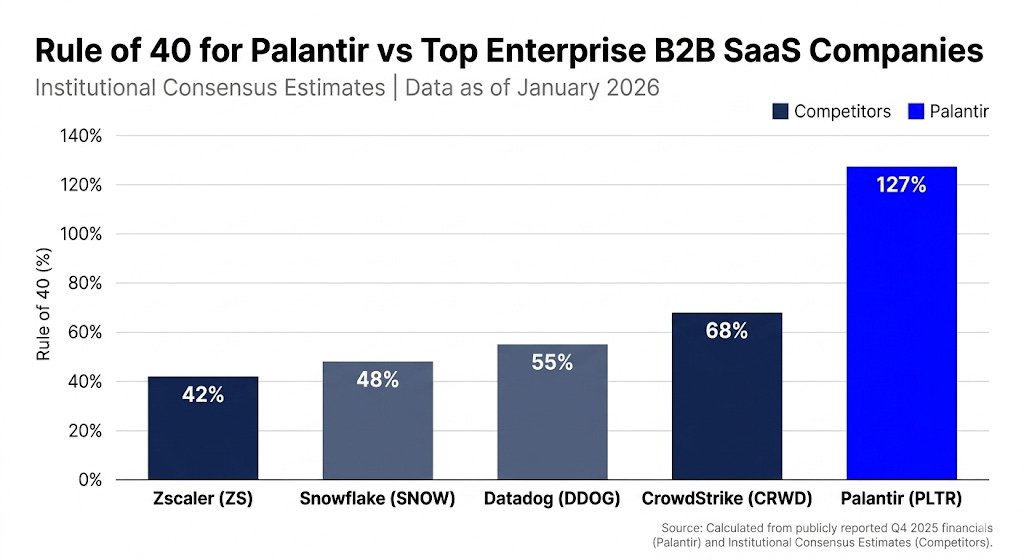
What belies all this? Alex Karp says “‘There’s nothing that we did at Palantir in building our software company that’s in any MBA-made playbook…Not one. That’s why we have been doing so well.’” Let’s find out why.
Basics: the problem, opportunity, and product
In 2000, PayPal was trying to scale its online payment system while playing a proverbial game of wack-a-mole against international fraud syndicates. Its algorithms to detect and decline suspicious transactions worked briefly, but the syndicates adapted and repeatedly skirted past the fraud detection algorithms. So, Paypal made a backend system named “Igor” that sifted through transactions, surfaced the most suspicious transactions, and had humans prosecute the fraudulent ones.
It was 2003, and the 9/11 Commission Report revealed a simple, but massive problem: the US government had a data problem that created the conditions to allow the 9/11 attacks. This was not from the need of data, either. The government was drowning in data from informants, wiretaps, and satellites. Rather, the government failed to understand the relationships between its troves of data. The FBI could not cross-reference a flight log with a CIA report. No infrastructure existed to integrate disparate data points and map networks between them.
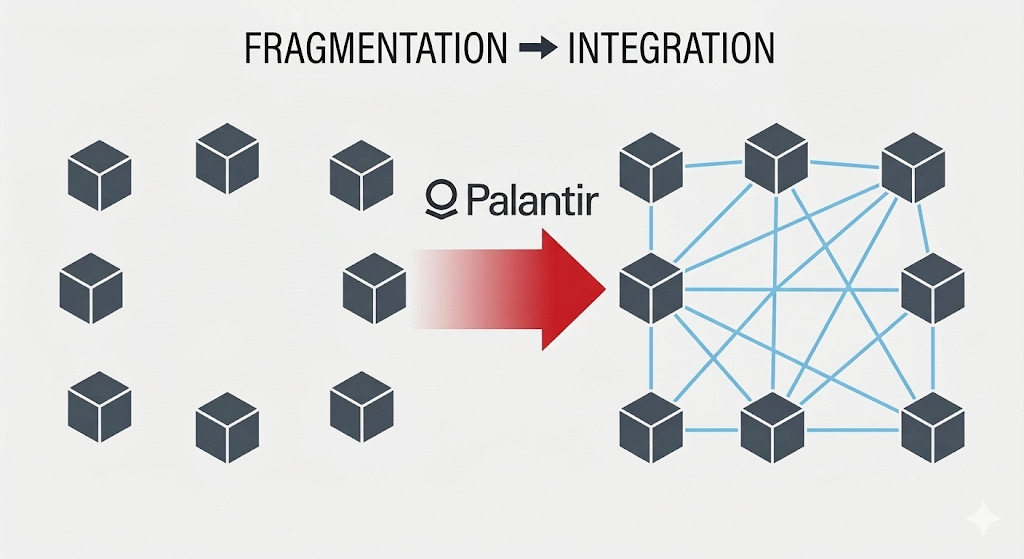
Peter Thiel recognized the government could adapt PayPal’s technical architecture to track terrorist and criminal networks around the world. So, he started building Palantir (more on that later). For now, let’s focus on Palantir’s four core products: 1.) Gotham, 2.) Foundry, 3.) Apollo, and 4.) Artificial Intelligence Platform (AIP).
Gotham: the OG platform. Gotham takes all data-- structured and unstructured-- like human intelligence (HUMINT), signals intelligence (SIGINT; think radio transmissions or emails), or drone feeds. It then integrates all of this data into a single pane. Gotham maps terror networks or manages battlefield targeting in a simple, concise, actionable format.
Foundry: Gotham’s commercial sibling. Foundry does what Gotham does but is tailored to large corporations. Foundry tracks manufacturing bottlenecks and supply chain disruptions for commercial aviation or healthcare.
Apollo: tactical edge enablement. This is the deployment infrastructure that permits Palantir platforms to work seamlessly in a nuclear submarine or other rugged environments.
Palantir AIP: LLM capabilities for users. AIP connects LLMs into any Palantir data integration platform an organization uses. A unit commander can interact with a chatbot about readiness metric trends, or a procurement manager can ask a chatbot for a summary on delayed shipments.
What Palantir’s success tells us
Honestly, I thought of AI targeting terrorist cells when I thought of Palantir a year ago. Palantir’s focus on the oft-unremarkable fundamentals of problems, however, explains so much of the value it’s created to date. One of Palantir’s most lucrative military contracts deals with back-office stuff: logistics and personnel readiness. The Army once had over 180 systems tracking its supply chains, maintenance, and personnel readiness, and none of these systems cross-communicated. Enter Palantir and Army Vantage. Vantage enabled contracting officers to discover $3.3b in funds that could be shuffled to active priorities. Now, over 100,000 users track unit readiness through Vantage, and the Army expanded their partnership with Palantir in late 2024 with a $618.9mm contract ceiling.
So, what’s so instructive about this as it relates to defense innovation? Indirect yet simple solutions are often the best. Palantir has never sold its users a silver bullet. Let’s call 9/11 the initial problem Palantir sought to solve. Palantir never offered a direct means to solving this. Its irreducible value proposition was: open data silos → synthesize data into actionable insights. Its founding team recognized a powerful truth: the best solutions to massive problems often don’t solve the problems themselves; they help the problem solvers to elegantly solve the problem in a big way. The defense and intelligence community is a treasure trove of gifted problem solvers. So many of the problems around defense innovation require this simple solution framework that aims to remove handicaps from the people that solve the problems-- from non-physical data silos to physical supply problems.
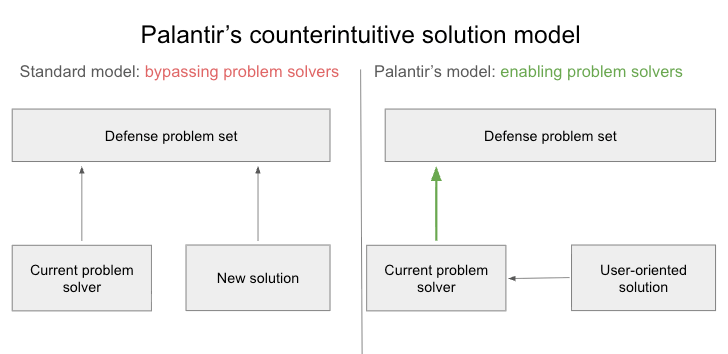
We often forget to stop and understand problems at the expense of a bias to action. Palantir avoided this pitfall. What’s more, a deep understanding of their end user reigned supreme in their early days through the forward deployed engineer. This bypassed the feedback loop between sales and development. Instead, software engineers went and wrote code directly for end users, and this went far beyond Pentagon boardrooms.
Engineers went to warzones in Iraq and Afghanistan and worked shoulder to shoulder with troops mapping insurgents on white boards. There was no longer a software update cycle. Engineers wrote code, integrated databases, and pushed the updates on the spot if an intelligence analyst needed something. Palantir’s proximity also allowed them to proactively shape their products. Early engineers saw the friction of FBI analysts logging into one database to see a license plate, write it down, and log into another database to check for the license plate number. Gotham is a product of precisely these observations. All of this tells us something incredibly clear: the best solutions are informed directly from those not just close to the problem, but directly in the problem. Where there is successful defense innovation, there is a fiendish obsession with the end user.
So, is defense innovation at its best when we marry Star Wars-like technology with relatively conventional business playbooks? Palantir tells us otherwise. Opening up stovepiped data is conceptually simple. Palantir’s early team simply understood the power of enabling existing end users and integrating their products with unyielding end user obsession. Defense tech builders have no shortage of imagination. Pairing that imagination with dedication to understanding both the problems they want to solve and the existing professionals who solve them is what will separate those who tried from those who enduringly disrupted the defense industry. Are we putting in enough sweat equity to put end users in all things-- end user hardware, manufacturing, and autonomous systems, to name a few-- first?
I was def one of the “fancy red wine” drinkers before this article. Really appreciate the way you gave context on Palantir and how it rose to fame. Thanks Alex!